Spotting AI-Generated Content: What to Look For (Text, Images, Video, Audio)
In one widely reported 2024 case, an employee at the engineering firm Arup joined a video call with what looked and sounded like the company's CFO and several colleagues. Every other person on that call was an AI deepfake. He transferred roughly $25 million before anyone realized.
The tools to create convincing fakes are free and getting better every month. The tools to detect them are playing catch-up. For now, your best defense is your own eyes, ears, and a healthy skepticism toward anything that seems too perfect or too outrageous.
Here's what to actually look for.
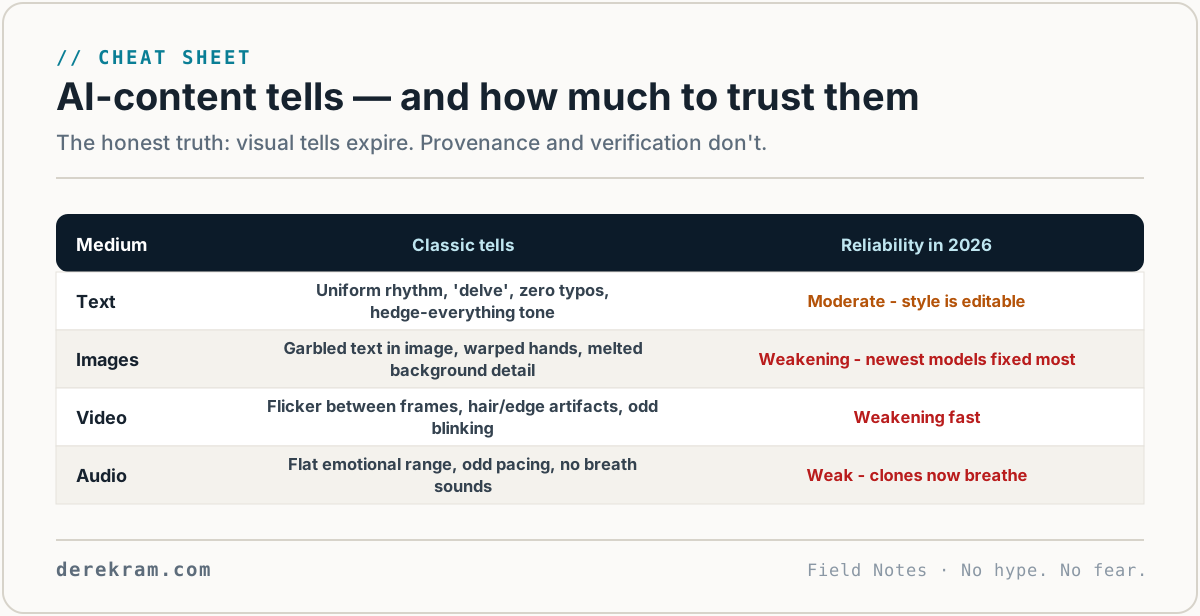
AI-Generated Text: The Tells Are in the Word Choices
AI writes differently than humans. Not worse — differently. Once you see the patterns, they're hard to miss.
Repetitive sentence structure. AI loves the pattern: Statement. Explanation of statement. Example of statement. Transition to next statement. Over and over. Human writing varies rhythm. AI writing marches.
Overuse of transition words. "Furthermore," "Moreover," "Additionally," "Consequently," "In conclusion." These appear in human writing too, but AI deploys them mechanically. One per paragraph, like clockwork.
Balanced, safe conclusions. AI rarely takes strong positions. "While there are valid arguments on both sides..." "Ultimately, the decision depends on individual circumstances..." This is AI hedging because it was trained to be uncontroversial. Humans have opinions.
Generic examples. AI examples feel like they were drawn from a textbook: "For instance, a small business owner might..." "Consider a student who..." Real human examples are specific and weird.
The word "delve." I'm serious. If you see "delve," the text is probably AI-generated. GPT models love this word to a pathological degree. Other tells: "crucial," "robust," "seamless," "ever-evolving," "in today's digital landscape."
No typos or grammatical errors. Humans make mistakes. AI text that's been generated but not heavily edited is suspiciously clean. If it reads like it was proofread three times by an English professor, someone — or something — put in that effort.
The "AI smell test" that actually works: Read the first paragraph. If you can't tell whether a human or a machine wrote it, scroll to the middle and read a random paragraph. AI text is evenly polished throughout. Human text has hot spots and cold spots.
AI-Generated Images: Look at the Details
AI image generators have gotten very good. But they still struggle with specifics.
Hands and fingers. The classic tell. Six fingers, fused fingers, fingers that bend in impossible ways. AI is getting better at hands but still messes them up — especially in group photos.
Text in images. AI can't spell. If an image contains words — street signs, store names, book covers, posters — look closely. The letters will be misshapen, garbled, or just random shapes that look like text from a distance.
Ears and eyes. Ears are inconsistently shaped. Eyes are often slightly different sizes or pointing in slightly different directions. Pupils may not match.
Background artifacts. Objects that blend into each other. A lamp that's also part of a curtain. A chair leg that disappears into the floor. AI fills space with plausible-looking stuff that falls apart on inspection.
Lighting inconsistency. Shadows that don't match the light source. Reflections that show something different from the scene. AI doesn't understand physics — it understands what lighting usually looks like.
Too perfect. AI faces are often slightly too symmetrical, too smooth, too evenly lit. Real faces have texture, asymmetry, character. AI faces look like they walked out of a skincare ad.
The teeth. AI teeth are often too many, too uniform, or slightly wrong in a way that triggers the uncanny valley. Count them. If there are way more than 32, it's AI.
AI-Generated Video: Movement Is the Weak Point
Video is the frontier. Text-to-video tools are getting scarily good, but they still have tells.
Movement physics. Hair doesn't move naturally. Cloth doesn't drape or fold correctly. Objects thrown in the air don't follow real arcs. The physics of motion is hard to fake.
Face transitions. When an AI-generated person turns their head, the face sometimes warps during the turn — like a morph between two reference images rather than a continuous 3D head rotating.
Lip sync. AI-generated speech doesn't perfectly match mouth movements. There's a slight disconnect, especially on complex sounds.
Blinking patterns. AI people blink too regularly or not at all. Humans blink at irregular intervals. Blinking used to be a dead giveaway; newer models have largely fixed it, so treat it as a weak signal only.
Background flickering. Objects in the background may flicker, change shape, or disappear between frames. Even modern video models that track a scene over time still slip on fine detail between frames.
AI-Generated Voice/Audio: The Cadence Is Off
Emotion is flat or misaligned. AI voices can simulate emotion — anger, sadness, excitement — but the emotional tone often doesn't match the content. A sad statement delivered with slightly cheerful inflection. An angry statement that sounds more like a firm request.
Breathing is wrong. Humans breathe between sentences. AI voices don't — or they breathe at mathematically regular intervals that don't match natural speech patterns.
Background noise consistency. Real phone calls have ambient noise that varies slightly. AI-generated calls often have perfectly clean audio or a single background noise loop that repeats.
The "reverse test." If a voice call sounds too clear, too consistent, with no pauses, no ums, no interruptions — be suspicious. Real phone calls are messy.
What to Do When You're Not Sure
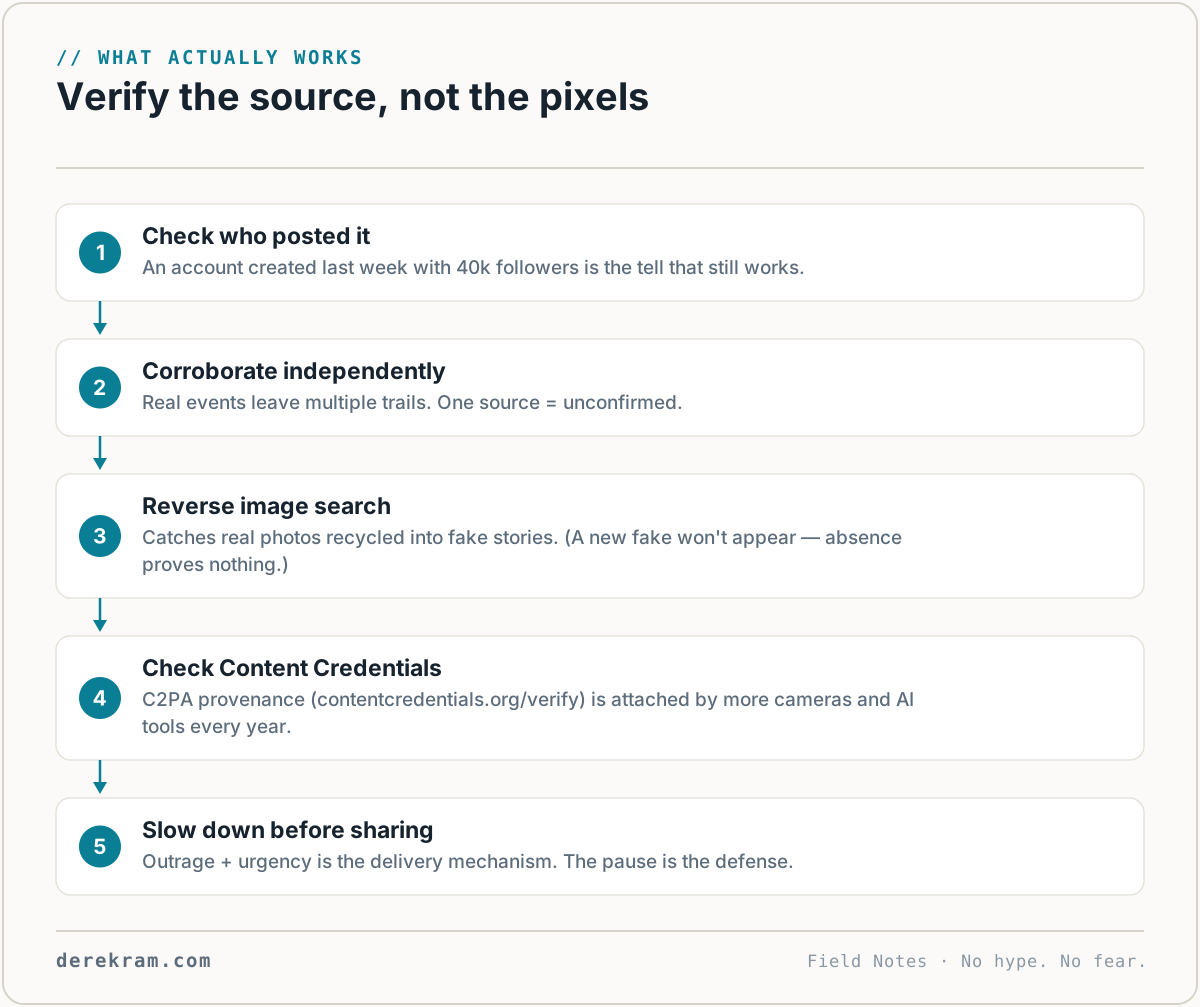
1. Check the source. Who posted this? Have they posted similar content before? What's their track record? A new account posting sensational content is a red flag.
2. Look for corroboration. Is anyone else reporting the same thing? News organizations, fact-checkers, subject-matter experts? If only one source has this "story," be skeptical.
3. Reverse image search. Right-click → Search image with Google. If the image is AI-generated, you won't find it elsewhere. If it's a real photo used in a fake context, you'll find the original.
4. Check the metadata. Not always available, but if the file contains metadata, AI generation tools sometimes leave signatures. Tools like exiftool can read it.
5. Slow down. The reason AI-generated disinformation works is the same reason scams work: it makes you react before you think. The content is designed to provoke an emotional response — outrage, fear, excitement. If you feel a strong emotion while consuming content, that's your cue to slow down and verify.
The Bottom Line
The detection tools are getting better, but the generation tools are improving faster. The gap is widening, not closing.
You don't need to be able to spot every fake. You need to be suspicious of the right things: sensational claims, emotionally charged content, and anything that asks you to act quickly.
The same 30-second scam test I teach for fraud works for fake content too. Who made this? Why now? Is this normal? What happens if I'm wrong? Who can verify?
AI Verification Checklist — a one-page guide to spotting AI-generated text, images, video, and audio. Free with the list.
[Join the Digital Self-Defense list →]
Get the 5-Minute Digital Safety Checklist
Four things that make you harder to target. No jargon. No fear. Free.
Get the Checklist →